
September 2026 Clinical Supervision Topic: Asking for Feedback
This past month in group supervision, I found myself saying it is the client’s experience that matters most. Theory, modalities, wisdom, instinct, experience...all of these matter. But the client’s experience takes the cake. It guides the goals, process, and relationship.
We’ve studied asking for feedback in the past, and I think it’s worth revisiting every year.
Here is a very short video from John Norcross, one of the leading researchers on what is effective in therapy. In it, he says we can focus on three simple questions.
So, as you go about your interactions with clients this month, I encourage you to give this a try. Whether you’re doing therapy, case management, crisis work, care coordination, skills work, assessments, or something else entirely, see if you can find ways to ask:
How do you think our work together is going? Are you getting what you want and need here?
How are we doing? Do you feel comfortable and understood in this relationship?
What would you like more or less of from me?
And then, listen to what they share and let it shape the work.
Lastly, I wanted to share this handout from Susie Snyder, LCSW. As you may already know from working with me or reading my newsletters, Susie has been a significant mentor for me over the years, ever since I took her child and family therapy class at Portland State in 2008/2009. She is an incredibly skilled, hard-working, constantly-learning clinician.
Susie’s handout is a really great, straightforward way to develop and practice the muscle of asking clients: What’s it like here for you?
I think that question is worth coming back to again and again. Our knowledge, experience, theories, interventions, resources, and ideas about our work do matter. But none of them can tell us exactly what it is like to be the person on the other side of the interaction.
We have to ask to truly know.
Looking forward to seeing you all this month.

July 2026 Clinical Supervision Topic: Congruence, Authenticity, and Internal Family Systems
We are on the sixth and final step of our rupture and repair series. Nice work!
Here it is:
enjoy a stronger, more honest, more real relationship with the lovely human in front of you.
I mean, I did kind of write this step just for fun. But, why not spend a month on it? Maybe it will indeed be fun!
When I think about when I most enjoy the person and relationship in front of me in a clinical setting (which I’m differentiating here from a social setting, as the expectations are a bit different socially than clinically), I realize it is when I am the most relaxed, present-focused, easy-going-but-intentional, curious, and compassionate. Not the polished or performing parts of me that tend to show up when I'm anxious or disconnected from my own intuition. The parts trying to get it "right." The parts operating from shoulds, pressure, obligation, fear, or guilt.
When I’m just, well, me. And, likely, you. To some extent, I’d guess?
I kind of believe the Internal Family Systems and AEDP ideas that we are all sooo good and golden at our core. So I’m guessing the Cs that I feel when I’m at my best as a clinician are similar to what you experience when you’re at your best in your role.
And, good news. Not only is it good for US to feel good in our work, turns out, according to common factors research, us being our most genuine, authentic and congruent selves has a very positive effect on the people we interact with daily, even our clients!
That got me wondering: if congruence of the clinician is one of the common factors in effective clinical work, where does it come from in us?
What creates the conditions where I naturally become more myself?
Because I’m not always in that state all the time. No one is. So I’m guessing we all have this question: what makes me feel most myself with: a. another person in general, and b. my clients?
For many of us, a big part of the answer is physical and psychological safety, which then creates the conditions where we can begin listening inward.
External safety matters. If my nervous system doesn't feel physically or psychologically safe, authenticity isn't really the goal—survival is.
But once enough safety is present, another question emerges:
How do I become more connected to myself while I'm with another person?
What I've found is that I feel most connected to myself when I'm in relationship with all the different parts of myself, and when they feel seen, heard, and respected enough that we can work together instead of against one another.
As that internal relationship has strengthened, something interesting has happened: congruence has required less effort. It seems to emerge naturally. I'm simply more me with the person sitting across from me. And, perhaps not surprisingly, I enjoy them more, too.
The person and relationship before me are enjoyed. :)
For me, that inner parts work has looked surprisingly simple.
It's becoming more familiar with my own internal system.
Learning to notice my parts.
Listening to them.
Thanking them.
Understanding what they're trying to do/what they need.
Helping them trust that they don't have to take the lead in the clinical work, but I’ll let them know if I want them to, thank you very much.
Congruence isn't a performance. It's a byproduct of an internal relationship.
Here are a few videos that will show you a bit more of what I'm talking about (using more IFS language, which may be helpful): 1, 2.
See you all soon.

June 2026 Clinical Supervision Topic: Processing Emotions through the AEDP Change Triangle
Welcome back dear colleagues and friends.
We are doing the 5th step in our rupture and repair work: After all is said and done (the whole strike-when-the-iron’s-cold concept), and once safety is restored, we turn our attention to a simple and powerful question:
What was all of that like for you?
This is where some of the deepest healing often occurs.
We are going to do this through the very effective AEDP tool of the change triangle. (Huge thank you to Jennifer who reminded me recently of the power of this tool).
The Change Triangle offers a gentle roadmap for helping clients move beyond thoughts and narratives and into the emotional experience itself. In this context, we're using it to explore the residual impact of the rupture: What emotions were stirred? What happened inside the client? What needs emerged? And what remains with them now that the immediate crisis has passed?
Let's take a look at how this process unfolds.
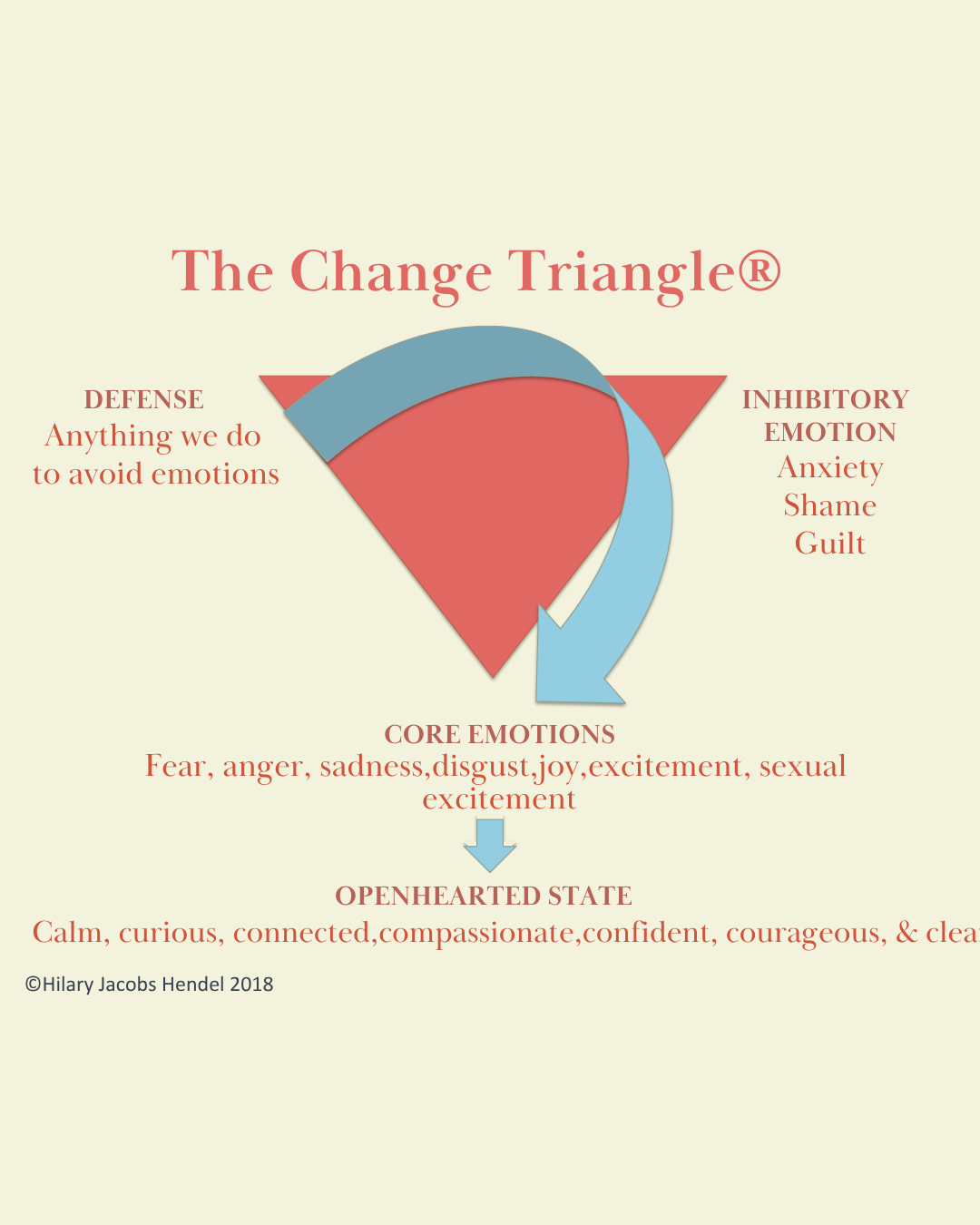
In preparation for supervision this month, feel free to read more about it here, and be sure to check out the list of defenses (i.e. ways we avoid emotions).
Another resource I like to share (thanks to Mallory for sharing it with me) when I’m helping clients move through the change triangle towards accessing emotions is this chart about the felt sense of various emotions.
Our deliberate practice skill this month will be experientially guiding clients through the Change Triangle to access their core emotions.
While the model itself can be nuanced, we're going to keep it simple. Our goal isn't to perfectly execute AEDP. Our goal is to help clients move from thinking about their experience to experiencing it in the moment with us.
The process looks something like this:
Slow down.
Notice bodily experience.
Connect with emotion.
Stay with emotion.
Explore adaptive needs, wants, and impulses.
A few questions that can help guide the process:
1. Slow Down
Let's pause for a moment. What's happening right now?
As you talk about that, what do you notice?
Can we slow down and stay with this for a moment?
2. Notice Bodily Experience
What are you noticing in your body right now?
Where do you notice that?
What sensations are present? (e.g., tightness, heaviness, warmth, tension, numbness)
3. Connect with Emotion
Looking at the emotions chart, what feeling seems closest?
What emotion might be here?
If you had to guess, what are you feeling right now?
4. Stay With Emotion
Can we stay with that feeling for a moment?
What happens as you pay attention to it?
Is there more there?
5. Explore Adaptive Needs, Wants, and Impulses
What does this feeling need?
What does this feeling want you to know?
If this feeling could speak, what would it say?
Remember: you don't need to ask every question. Follow the client's experience. These prompts are simply doorways into deeper emotional processing.
Come ready to slow down, get curious, and try out some new skills.
You’re doing great.

May 2026 Clinical Supervision Topic: Accountability in Clinical Work
Hello.
We’re continuing our conversations on rupture and repair in the clinical space, in line with our annual theme of Returning to Connection.
The step, according to our post back in February, is “making it better”. Yes, I realize this is something we say to children, make it better. And I guess I’d like to bring the child-like mindset to this month’s work. Something I find so special about children is that they are so good at having a non-defensive, non-protected stance. Yes, they do lie sometimes, and try to get away with things, especially when going through their experimental phases of learning cause and effect. But they are not sophisticated in their defenses, and they drop them pretty quickly, generally speaking.
Why does this matter?
Well, I don’t know about you, but it’s very hard to not go into my own protective/defensive strategies when I’ve made a mistake, and especially when I harm someone. It takes me a minute to settle, to tolerate the exposure of being seen in a mistake, to deal with the guilt (and sometimes shame) that can come up after learning I’ve caused another harm (and the greater the harm, the greater the protectiveness, at times). I deeply care about the people I work with. I hate when I’ve made a mistake that causes them harm. I do not wish to cause them any suffering.
Ok, that got heavy. And this work can be heavy, but it doesn’t have to be in order to be effective. Not all the time anyway.
So, back to children. Let’s learn from them and their approach. Let’s be open and curious when we cause harm in the clinical space. Let’s trust the process of learning from our mistakes. And most of all, let’s listen, with an open heart, to understand the impact of our mistake. If a client is willing to share this, and sit with us and allow us to learn, change, and grow right in front of them, than we can do what is needed to repair the harm.
(Not all clients will give us this opportunity. And that’s a really good thing to bring to supervision. You deserve support too.)
When they do, we can listen closely to the exact way the rupture impacted them, and we can try and find ways to take accountability (naming the exact action, and the precise harm), and move into doing differently going forward. It will likely take some good listening, and some consistent nurturing of the relationship, along with not repeating the mistake.
I mean, it’s really, at the end of the day, just like any true, real relationship.
Ok, so this is a long, meandering way of saying: we’ll be practicing accountability statements this month. In whatever way that looks for you.
What does an accountability statement actually sound like? Here are some bare-bones examples, organized loosely by the type of rupture. These are starting points, not scripts. Your genuine words, in the moment, will be shaped by your client, your relationship, and what actually happened.
Misattunement / missing the emotional tone:
"I think I moved too quickly past something that really mattered to you. I was focused on [X] and I missed how much pain was underneath what you were sharing. I'm sorry for that."
"I responded in a way that felt clinical when you needed something warmer. That's on me."
Saying something that landed wrong:
"When I said [X], I can see now that it came across as [dismissive / minimizing / judgmental]. That wasn't my intention, but I hear that it hurt, and intention doesn't erase impact."
"I used a word or framing that didn't fit your experience. You know your experience better than I do, and I should have led with curiosity."
A boundary or structural rupture (lateness, scheduling error, etc.):
"I was late and that cost you time. I probably sent a message I don't want to send, that your time doesn't matter. It does."
"I made an error with [scheduling / billing / a note] and I want to own that directly rather than gloss over it."
Pushing too hard / moving too fast:
"I kept returning to something you'd already told me you weren't ready for. I didn't honor your pace, and I can understand if that felt like pressure."
One thing to notice across all of these: the structure is generally name the action → name the impact → resist over-explaining your intention. The temptation is always to explain why you did the thing. Resist it, at least at first. Your client doesn't need your reasoning first. They need to feel seen in their experience first. The explanation, if it's even needed, can come after.
More to come, see you all in supervision.

March 2026 Clinical Supervision Topic: Empathic Reflections
What is the skill criteria for empathic reflections, and why do we even do these reflections? Like, we all know we should. But why?
First, skill criteria is here. Practice, practice, practice. Honestly cannot wait for you all the practice your skills on me. I LOVED being empathized with. And, as always, for the person receiving the empathy (i.e. the practice client), it’s easier to choose to share something that matters to you (but isn’t too heavy), so you can feel the impact of being empathized with experientially, and so you can give really attuned, adept feedback to the practitioner.
Ok, so why empathic reflections? Let’s look to Accelerated Experiential Dynamic Psychotherapy (AEDP) for our answers.
AEDP places empathy at the center of the work. Diana Fosha designed the model around the idea that healing happens when emotional experience is fully felt in the presence of an attuned other. Your empathic reflections are one of the main mechanisms that make that possible.
In AEDP, empathic reflections are not just paraphrasing. They are active, precise tracking of emotional experience in real time.
Instead of
“Sounds like that was hard.”
An AEDP reflection might be closer to:
“When your mother dismissed you like that, I can see how painful and lonely that felt. And at the same time I notice how clearly you’re standing up for yourself now.”
Or:
“As you talk about this, I see your eyes filling. Something very tender is here.”
These reflections do several things neurologically and psychologically:
• regulate the nervous system
• help the client recognize and organize emotional experience
• deepen affect rather than bypass it
• highlight transformational affects like relief, pride, or grief (transformation affects are big in AEDP)
AEDP assumes that trauma and attachment wounds happen in isolation, or as Fosha says in this interview, “unwilled and unwanted aloneness in the face of overwhelming emotion”.
Not just that something bad happened, but that:
the person had to go through it alone
their emotional experience was not witnessed or held
So the therapy relationship actively works to undo that original aloneness.
Empathic reflections are the vehicle through which aloneness gets undone.
When a therapist accurately reflects a client’s emotional experience:
The client feels seen
Their nervous system co-regulates
Their emotional experience becomes shared
The memory gets reconsolidated with a new relational context
Instead of:
“I suffered alone.”
The nervous system learns:
“Someone can be with me in this.”
If you want to take this skill a step further, you can do what Fosha is talking about in her video (linked above) at minute 25:36, where she starts with, “empathy needs to be taken in. . .”. , and check on how your empathy is landing with your clients, and if they can feel your care and presence in that very moment.
Beautiful, right? This is really beautiful work that we get to do. So that’s what we’re up to this month. :)

February 2026 Clinical Supervision Topic: Rupture and Repair
There are a lot of valuable ways to relate to people, and a lot of new skills to learn, practice, remember, etc. in our work. One thing that keeps us from trying new things, though, is the fear of rupture. We don’t want to hurt/upset/re-traumatize the people we serve. Of course we don’t.
I’ve found myself quite comforted by remembering that rupture is inevitable in most real relationships. Repair, is optional. Let’s do repair, every time.
It is not lost on me that in homes and environments with trauma, repair is often missing. The painful thing/harm happens, and it goes unacknowledged, unsupported, unexplored, and there is no re-connection. Well, in our work with people, we get to do that. And it is soooo restorative for the relationship.
But how do we repair? A few steps, to be honest.
We pause, and do an internal scan, if needed. Just slow down, and feel. Even if it’s painful. (I hate causing ruptures, and always want to hide my head under a rock. I guess that’s normal, so if you feel it too, we’re in this together).
Tentatively reflect what you’re understanding the client’s experience to be, and ask if you’re tracking correctly.
Validate. What you’re saying/feeling makes sense because of A, B, C.
Make it better (find some way to make it up to them, if possible).
After all is said and done (the whole strike-when-the-iron’s-cold concept), and once safety is restored, ask what that was all like for them.
Enjoy a stronger, more honest, more real relationship with the lovely human in front of you.
It’s a lot, doing a repair. So with our theme of Returning to Connection, as well as our ongoing themes around common factors theory, interpersonal neurobiology, deliberate practice, and who knows what else at this point, we’ll slow it down, and take it one step at a time.
This month we’ll practice the internal scan. Because our nervous systems speak louder than we do. You already know this, of course. You genius.
We’ll use some of the videos from here and here to practice this skill together this month. Look forward to seeing you all.

January 2026 Clinical Supervision Topic: A Relational Orientation
This month is a short write-up, but a really important one.
It comes from our annual theme of Returning to Connection.
We’re going to focus our supervision sessions on staying in relational flow with clients. This comes from Interpersonal Neurobiology (IPNB), which understands the therapeutic relationship as something that is continually unfolding, dynamic, and co-constructed. The relationship is a system shaped through presence, timing, resonance, and emotional availability, often outside of conscious awareness.
From this lens (and this is relatively new to me), connection isn’t built by monitoring ourselves or reaching for the “right” technique. It happens when we stay with the relationship, the human-- especially in moments of uncertainty, intensity, or not-knowing. When we trust the process and resist the urge to step out and manage ourselves, something settles. Felt safety, attunement, and integration tend to emerge on their own.
By the way, this all aligns with common-factors research (which we’ve spent 6+ years on), which consistently shows that outcomes depend less on specific interventions and more on the clinician’s capacity to remain emotionally available when things get charged.
Staying with is what we’re practicing here, not as a performance, but as a way of being in relationship. For many of us, this is a lifelong endeavor.
I can’t wait to hear your thoughts.
Oh, and here’s a very interesting Bonnie Badenoch interview that touches on this.

2026 Clinical Supervision Theme: Returning to Connection
I wanted to write something profound and moving about our theme for the year…but I’m realizing that returning to connection is not some big, dramatic thing. It’s straight-forward in a really solid back-to-basics type of way. And the longer I’m in this field, the more I realize the beauty in the simplicity. Yes there are all kinds of fancy skills and new modalities coming out every day, which I love. I love that we’re getting more nuanced and in the weeds about how we help our fellow humans. But at the end of the day, in my book, it just comes down to connection. That’s what we’re doing.
How do we naturally, genuinely facilitate honest connection with other humans?
What kind of connection do we aim for?
How do we know when it’s there?
What are the internal and external skills we can develop to nurture connection over time?
How do we feel when someone connects with us? How do we feel when we connect with ourselves?
Just a few existential questions to send you down the rabbit hole. :)
So please kindly join me this year. We’ll be exploring initiating connection, sustaining it, repairing it, re-negotiating it, and the ongoing process of deepening it, both with ourselves (which directly informs the work) and with our clients, who are at the heart of it all.
I’m sure you saw this coming, but I look forward to connecting with *you*, yes you, this year. 2026 feels like a good one.

December 2025 Clinical Supervision Topic: A Reflection
It’s a fun one, I promise.
Hello.
As the year draws its end, I’m noticing what a hard year it has been, and how each one of us, more often than not, has been so committed to doing so much good in our various communities.
I want us to take this month to rest, restore, and connect.
If you’re up for it, I thought it would be fun to pick one of these questions and come ready to share your answer in group this month. I hope you like the questions below, but if you don’t, I’d love to hear anything interesting (or mundane!) you want to share about your year.
Questions to reflect on regarding this last year:
What are you most proud of?
When did you laugh the hardest?
Favorite moment with a client?
BIGGEST life takeaway from this year (personal or professional)?
Who supported you this year? And I mean really, in a nurturing way, supported you?
Or, you know, your favorite meal of the year. :)
Ok, see you all so soon.

October 2025 Clinical Supervision Topic: Strengths-Based and Solutions-Focused
So much of therapy drifts toward what is wrong. The pain is real and deserves care, it’s true. But if we stop there, we can accidentally miss reflecting back to our clients the beauty of their humanity. We also might. miss out on discovering their innate wisdom about what actually works for them.
This month let’s tilt the lens and see how it affects the people we care about.
Why this matters
Hope and expectancy. Naming strengths and imagining solutions helps clients believe change is possible.
Alliance. A strengths lens makes the work feel collaborative and dignifying.
Momentum. Small, solution steps often move the needle more than more problem analysis.
What “Strengths-Based” and “Solutions-Focused” mean
Strengths-Based
Clients already carry resources, capacities, and resiliency. We focus on what works, not only what is broken. This approach grew from social work and centers client self-determination and future outcomes.
Solutions-Focused (and/or SFBT)
Rather than digging into the full history of the problem, we orient to preferred futures, exceptions, and doable next steps. Solutions-focused is goal-directed and collaborative, often brief, and has a growing evidence base across settings.
Core Solutions-focused principles to know (I’m leaving out strengths-based because it’s so self-explanatory):
Focus on solutions, not problems.
Treat the client as the expert on their life.
Small changes can create larger shifts.
Look for exceptions, times when the problem eases.
Ask future-oriented questions, like the miracle question.
Use scaling to track movement and choose next steps.
Strengths-based practice in action:
A strengths stance says our job is not to install strengths, but to notice them, amplify them, and help people use them on purpose. It requires some humility on our part, I think. Try:
“How have you gotten through something like this before?”
“What would your best friend say you do well in hard seasons?”
“Which parts of you are already prepared for this?”
Solutions-focused tools you can drop into any orientation
Miracle question: “If a miracle happened and this problem was gone tomorrow, what would be different?”
Scaling: “On a scale of 1 to 10, where are you today. What moves you up one point?” (This one is actually borrowed from Motivational Interviewing).
Exceptions: “Tell me about a recent time the problem was quieter. What was different?”
These questions direct attention to preferred futures and exceptions, which can reduce distress and surface immediate steps. Evidence suggests SFBT achieves effects comparable to other evidence-based approaches, often in fewer sessions.
Integrating the lens without minimizing pain
Being strengths-based and solutions-focused does not mean bypassing grief or trauma. It means holding both truths. Suffering is real, and people also hold abilities, values, and support that can be mobilized now.
Try a mini-challenge this month:
Reflect at least one strength at the end of every session/encounter.
Ask one solutions-oriented question in each encounter.
Track what shifts in client engagement and your own stance.
Closing
When we remember to ask about strengths and solutions, clinical work becomes less about what is missing and more about what already is, and what’s possible.

August 2025 Clinical Supervision Topic: Eliciting Feedback and Motivational Interviewing
It’s easy to assume clients will tell us if something isn’t working. But most won’t…at least not directly. They might show up less engaged, try to push through, or quietly stop coming. We can prevent a lot of that by making feedback a regular part of the process, early and often.
Therapists who build space for honest feedback tend to have stronger alliances, better client retention, and better outcomes overall.
A few things we know about feedback:
Outcomes improve when we ask. Inviting client feedback using simple tools or open-ended questions significantly improves therapy outcomes and reduces dropout rates.
The best therapists get the most negative feedback. Not because they’re doing something wrong, but because they’ve created enough safety for clients to be honest.
Most clients won’t tell you directly. Especially if they think it might hurt your feelings. We have to actively invite it.
Motivational Interviewing is especially helpful here. It’s grounded in the belief that clients are the experts on their experience, including their experience of us. MI gives us a way to ask for feedback without making it feel clinical or pressured.
One MI framework I find especially helpful is OARS:
Open-ended questions
Affirmations
Reflections
Summaries
Each of these helps feedback feel collaborative rather than evaluative. For example:
Open-ended question: “What’s been most helpful—or not helpful—about today?”
Affirmation: “I really appreciate you saying that; it helps me understand how to support you better.”
Reflection: “It sounds like I might’ve missed what felt most important there.”
Summary: “So what I’m hearing is that this pace feels fast, and you’d like a little more time to process?”
Here are some other sentences that can gently open the door to process feedback:
“How is this feeling so far?”
“Did I miss anything important just now?”
“What’s been helpful today—and what hasn’t?”
“Is there anything I’m doing that gets in the way?”
“What do you wish I better understood about where you’re at?”
These questions are simple, but they matter. They let clients know their experience of the work—and of us—is part of the work. And when we respond with curiosity instead of defensiveness, it strengthens the alliance rather than threatening it.
Want to learn more?

July 2025 Clinical Supervision Topic: Therapist Effect and AEDP
For years, I’ve been thinking about therapist effect — why some clinicians (social workers, counselors, or therapists) consistently get better outcomes than others, no matter what methods they’re using.
Lately, I’ve been especially focused on two pieces of that puzzle: how we handle our own internal reactions (countertransference) and how we respond when things go off track in the relationship (rupture and repair).
We’re often taught to manage or suppress countertransference. But I’ve come to believe it’s not just something to “get out of the way.” Our feelings, sometimes unexpected, messy, or uncomfortable, can actually offer clues about what’s happening in the room. Ignoring them can leave important things unexplored.
And then there’s rupture and repair. Research keeps showing that how we navigate moments of disconnection is a big part of what makes some therapists more effective. People who can stay regulated, curious, and open during awkward or tense moments often help clients feel safer and more deeply understood.
This is where Accelerated Experiential Dynamic Psychotherapy (AEDP) has been so useful for me. AEDP doesn’t just offer techniques. It gives me a way to stay present and real, even when my own emotions are activated or when things feel strained with a client.
When it comes to countertransference, AEDP encourages me not just to notice my reactions but to use them thoughtfully. For example:
Moment-to-moment tracking helps me stay tuned into subtle shifts in my client’s feelings, body language, or energy. It keeps me curious and responsive to what’s happening right now. But when I notice strong reactions in myself, I know it’s important to pause and check in internally first. Instead of continuing to track the client, I might briefly turn inward, ask myself what’s going on, and decide whether my reaction belongs to me, to the client, or to what’s happening between us. Once I feel more grounded, I can return to tracking the client; or, if it might help the work, I can choose to share my experience in a thoughtful way.
Self-disclosure of my emotional experience allows me, when appropriate, to share what’s happening for me in a way that can deepen connection or bring relief to the client.
“I’m feeling really moved hearing you talk about this.”
These skills help me transform countertransference from something that might derail therapy into something that can create intimacy and insight.
When it comes to rupture and repair, AEDP offers tools that keep me grounded and connected, even when the relationship hits bumps:
Dyadic regulation (co-regulation plus intentional therapeutic interventions to help process emotion) helps me steady the client when emotions run high. It’s about creating safety so clients can keep exploring, rather than shutting down.
“Let’s slow down for a moment and take a breath together.”
Undoing aloneness ensures clients don’t feel abandoned during difficult moments, which is crucial for repairing ruptures.
“You’re not alone with this right now. I’m right here with you.”
Metatherapeutic processing allows me to talk with clients about what it’s like for them to have just gone through a hard or healing moment together, which can be part of solidifying a repair.
“How is it for you to feel this relief right now, after sharing all of that?”
AEDP gives me a map for how to lean into these vulnerable places instead of backing away. It’s one of the reasons I believe these skills are right at the heart of therapist effect.
A few questions I keep asking myself:
What’s my countertransference trying to tell me right now?
How do I notice a rupture, and what helps me lean into it instead of avoiding it?
Who am I as a clinician when things get messy?
How might AEDP skills help me navigate these moments with more presence and courage?
I’d love to hear how you’re thinking about this. How do you work with your own internal experiences in therapy? What’s helped you get better at rupture and repair?
PS: Be sure to come to the July 13th gathering I’m hosting in Portland, would love to see you in person!